
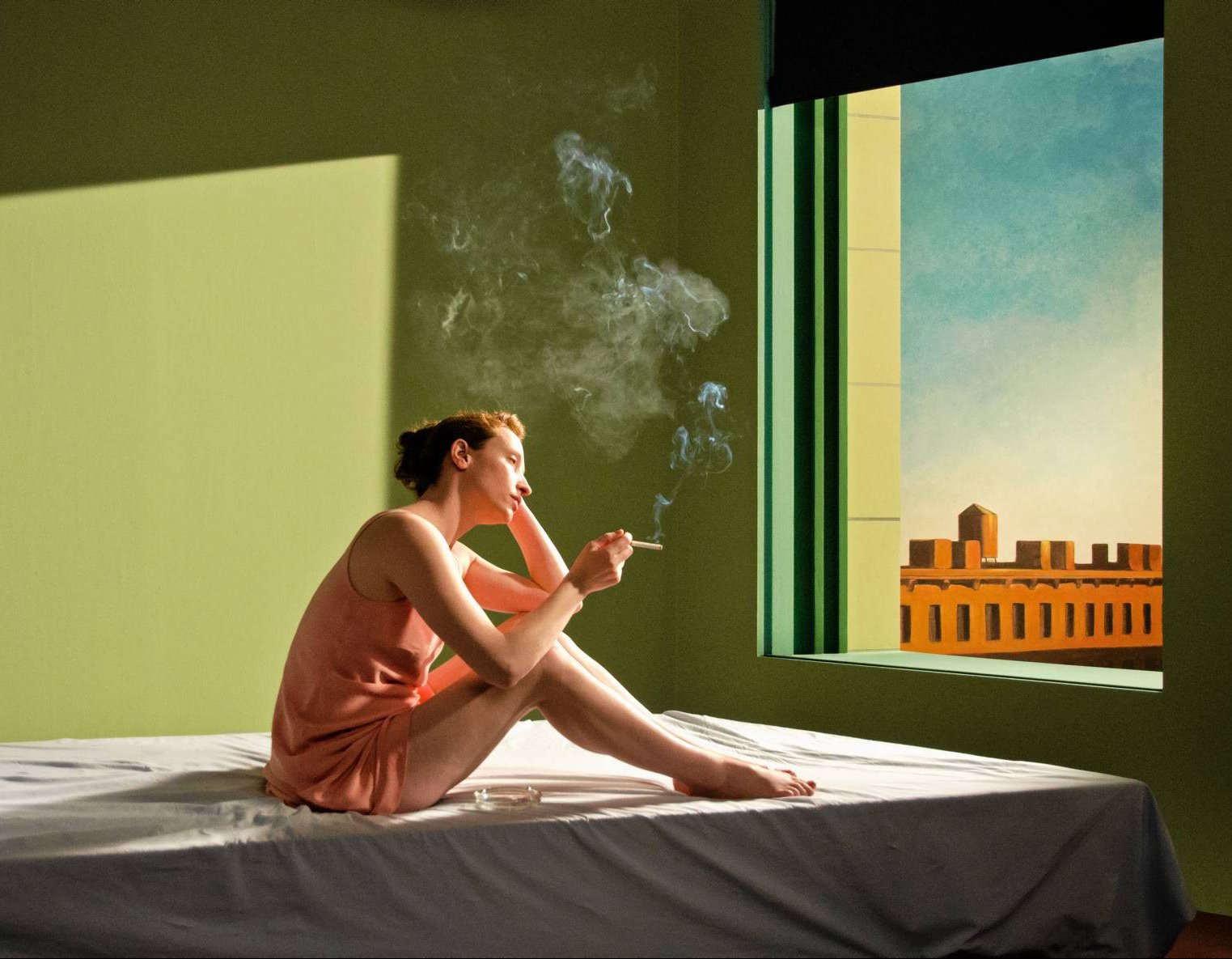
Fragment nigdy nie dokończonego szkicu o malarstwie Edwarda Hopper’a. Hopper zdecydowanie mój ulubiony malarz współczesny i możliwe, że kiedyś dokończę ten szkic, ponieważ moje zainteresowanie jego twórczością nigdy się nie wyczerpało.
Edward Hopper. Malarstwo totalne
W malarstwie tym wyraźne jest uchwytywanie wzajemnej zależności pomiędzy bezosobową przestrzenią, składającą się w głównej mierze z oświetlonych płaszczyzn (rozległych i jednorodnych), a postaciami ludzkimi przytłoczonymi tym bezmiarem obojętności masywnych ścian i fasad (Hopper nakłada na płótno grube warstwy farby), widzianymi często z lotu ptaka, wszelkiego rodzaju zabudowaniami i architekturą, a obecnością wśród nich ludzkich postaci. Hopper stawia człowieka, pokazanego w codzienności jego zajęć, wobec i wśród fragmentów masy materii, jaką stanowią budowle i inne artefakty kultury materialnej, zawsze ujmowane na tych płótnach częściowo, jakby w przypadkowym rzucie, a jednak stanowiące doskonałość kompozycyjną.
Ludzie przedstawieni na jego obrazach, szczególnie gdy portretowani są nadzy, właściwie nie stanowią antytezy nagości naświetlonych płaszczyzn fasad domów czy miejskiego krajobrazu. Są raczej zagubieni gdzieś w swoim życiu wewnętrznym, podczas gdy anonimowa przestrzeń czuwa, istnieje niepokojąco tyleż przez nich niezauważana, co obejmująca ich w całości. Właśnie ta podstawowa sytuacja, stawiająca człowieka gdzieś w środku przestrzeni od początku do końca materialnej, sytuacja w jakiej człowiek nie bierze właściwie udziału, przytłoczony, owładnięty przez rzecz, przez jej masywność i niewzruszoność – ta sytuacja stanowi doskonałą ilustrację ontologicznego zagadnienia stosunku podmiot-przedmiot.
Obrazy – Edward Hopper malarzem wnętrz architektonicznych i ludzkich
Domyślamy się życia wewnętrznego ludzkich postaci na tych płótnach i właśnie ta wewnętrzność jest konfrontowana z chłodną zewnętrznością kontekstu przestrzennego. Wprawdzie nie na wszystkich swoich obrazach artysta umieszcza postacie ludzkie. Często są to przedstawienia zupełnie wyludnionych miejsc dalekiej prowincji, obchodzących się znakomicie bez właścicieli, bez ludzkiego spojrzenia. Jednak idąc za tropem „humanistycznym” sztuki Hoppera, można wydobyć te elementy jego dzieła, które zaznaczają relację człowieka do rzeczy, przestrzeni w jakiej przebywa, czuje, myśli, działa.
Pytaniem jest więc pytanie o dotyk – dotykanie przez ludzką skórę zimnych szyb, murów, wszystkiego, co stwarza ramy przestrzenne dla prowadzenia przez człowieka jego życia: w domu, w biurze, w restauracji, na stacji benzynowej. Ten chłód milczących rzeczy dąży jednak do całkowitej neutralności, nie przedstawia się jako przeszkoda, rzeczy tworzą raczej środowisko, w którym możliwe są zwykłe ludzkie praktyki dnia codziennego.

The growing interest in this essay on Edward Hopper’s painting has prompted me to translate the critical reflections on his paintings into English.
Hopper: Human Space and the Space of Things
A fragment of an unfinished sketch on the paintings of Edward Hopper. He is undoubtedly my favorite contemporary painter, and it is possible that I will complete this sketch someday, as my interest in his work has never waned.
Edward Hopper. Total Painting
This painting clearly captures the interplay between impersonal space, consisting largely of illuminated surfaces (vast and uniform), and human figures overwhelmed by the vastness of indifference – massive walls and facades (Hopper applies thick layers of paint to the canvas), often seen from a bird’s eye view – all kinds of buildings and architecture, and the presence of human figures among them. Hopper places the human being, depicted in the everyday routine of his activities, in front of and among fragments of the mass of matter constituted by buildings and other artifacts of material culture, always partially depicted in these canvases, as if in a random projection, yet constituting compositional perfection.
The people depicted in his paintings, especially when portrayed naked, are not truly the antithesis of the nakedness of the illuminated surfaces of house facades or the urban landscape. Rather, they are lost somewhere in their inner lives, while an anonymous space watches over them, existing disturbingly as much unnoticed by them as encompassing them in their entirety. This very fundamental situation, placing the human being somewhere in the middle of a space that is material from beginning to end, a situation in which the human being does not truly participate, overwhelmed, possessed by the thing, by its massiveness and impassivity – this situation provides a perfect illustration of the ontological question of the subject-object relationship.
Paintings – Edward Hopper, a Painter of Architectural and Human Interiors
We intuit the inner lives of the human figures in these canvases, and it is this interiority that is confronted with the cold exteriority of the spatial context. Admittedly, the artist does not include human figures in all of his paintings. Often, these are depictions of completely desolate, remote provincial places, perfectly managing without owners, without the human gaze. However, following the „humanist” approach to Hopper’s art, we can extract those elements of his work that mark the relationship between humans and things, the spaces in which they inhabit, feel, think, and act.
The question, then, is about touch – the touching through human skin of cold glass, walls, everything that creates a spatial framework for human life: at home, in the office, in a restaurant, at a gas station. This coldness of silent things, however, strives for complete neutrality; it does not present itself as an obstacle; rather, things create an environment in which ordinary, everyday human practices are possible.
Zostaw odpowiedź